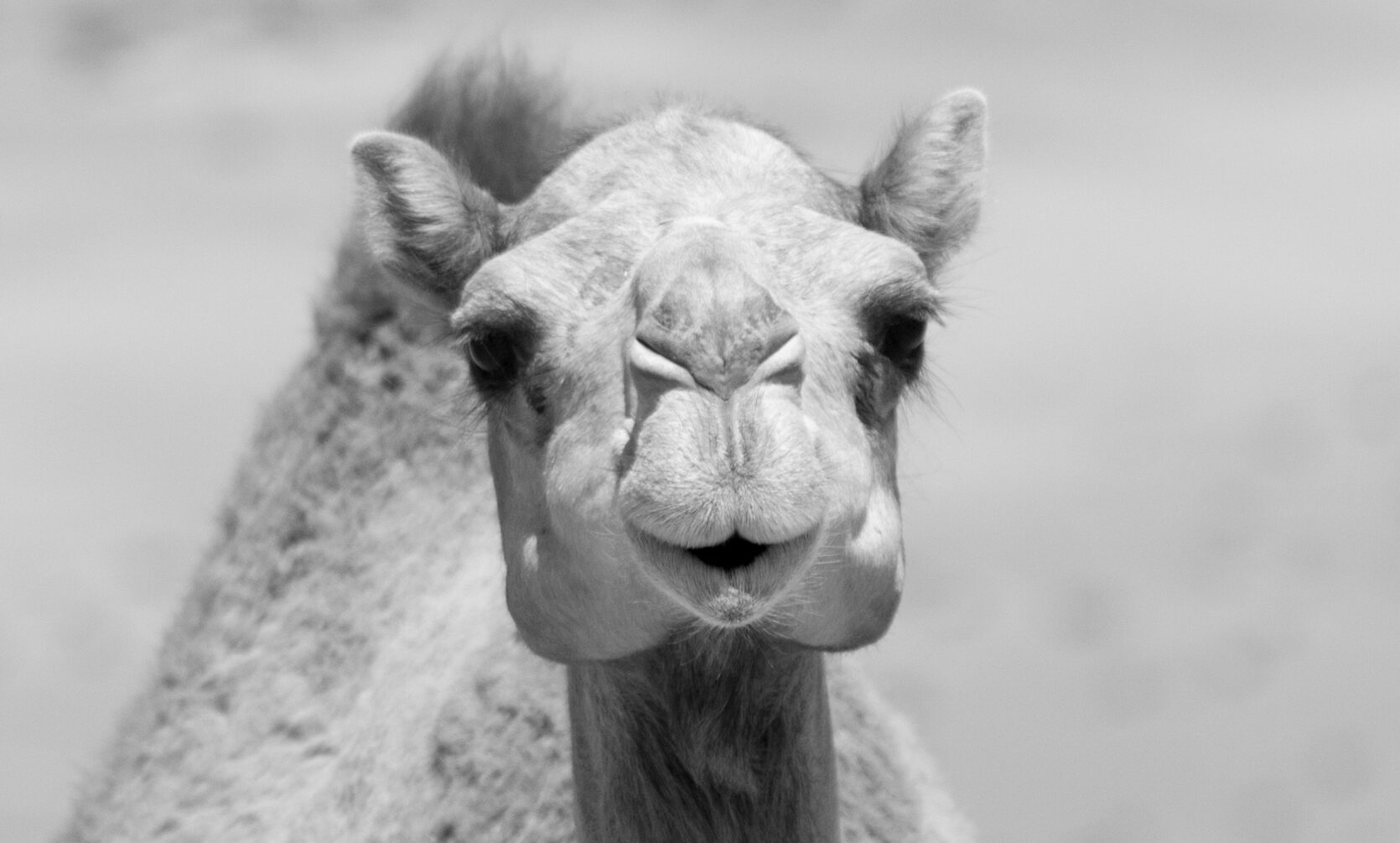
The Dromedary camel is deeply embedded in the cultural heritage from western Africa, the Levant and the Arabian Peninsula to Pakistan and India.
Their symbolism extends to various aspects of heritage: history, folklore, as well as religious practices. Discover the history, heritage and folklore of the Arabic Camel or Dromedary.
In this Article
The name Dromedary comes from Camelus (Latin) a camel and Dromeus (Greek) a runner; –arius (Latin) suffix meaning pertaining to: hence dromedarius (New Latin) a running camel.
It is also called the Arabic camel or “one-humped camel”. It actually has two humps, although only the rear one is fully developed. That is what a camel sounds like.
The dromedary is valued as a source of power, fortune and delight, wrote the Arabic historian Al-Jāhiz, who described it as a “complete animal” for human beings. It is exceptionally well-adapted to long periods of drought and heat and can survive and reproduce in conditions intolerable to other domestic animals.
Navigating sands of time – On the History of the Camel (Dromedary)
In the expansive desert realms, the bond between nomads and camels narrates a story of survival and interdependence. The inhabitants of these harsh landscapes have historically relied on these noble beasts in their quest for life’s necessities.
Earliest evidence of wild camels in the Old World
Recently, in Northern Arabia’s Nefud Desert, life-sized stone engravings of humans, camels, wild donkeys, ibex, gazelles, and an aurochs were found. The rock art was dated between 12,800 and 11,400 years ago.

In the wild, the dromedary inhabited arid regions, including the Sahara Desert. Over time, hunting, habitat changes, and especially widespread domestication led to the disappearance of the wild populations.

In Somalia, paintings in Laas Geel figure dromedaries from more than 5,000 to 9,000 years ago (although these dates are disputed amongst historians).
Today, all dromedaries are domesticated or feral (animals that escaped and live in the wild but descend from domestic stock). The Wild Bactrian Camel (with two humps) , still survives in small numbers in parts of China and Mongolia, though it is critically endangered.
A significant feral population occurs in Australia – camels introduced by humans in the 19th century.
Domestication of the camel
The domestication of the Bactrian Camel

The Black Obelisk of the Assyrian king Shalmaneser III (r.858-824 B.C.), is thought to contain the oldest representation of domesticated camels (Bactrians). On this obelisk the inscription says “tribute of the land of Muṣri” (Egypt).
Biological and archaeological evidence point to the fact that the domesticated Bactrian camel first appeared in the cold desert region of southern Kazakhstan, northwestern China and western Mongolia, overlapping with the present distribution of wild populations, remain the most plausible region for early Bactrian camel domestication around 5000- 6000 BC.
Although the exact location remains uncertain, from these desertic landscapes the Bactrian then arrived in Turkmenistan, Afghanistan, Pakistan and Iran, and subsequently in Mesopotamia.
The domestication of the Dromedary Camel
In Mesopotamia, the Sumerian term
anše.a.ab.ba
“Donkey or ass of the sea”,

was used for the Dromedary, around the middle of the 2nd millennium BC.
This implies that the “donkey of the sea” reached Mesopotamia from across the sea and that it appeared there in its fully domesticated form.
During the Neo-Assyrian period (ca. 900–600 BC), the dromedary, mostly written as “donkey of the Sea[land]” or as gammalu (cf. our word for “camel”), appears in large numbers in campaign reports and booty lists. Expectedly, it is often mentioned in connection with north Arabian queens or kings
Dromedary bones from the Iron and the Bronze Age indicate a shift from hunting to herding camels that occurred between about 1400 and 900 BC and which puts South-East Arabia at the crossroads of the early history of dromedary domestication.

Another solid evidence of domestication is from Qasr Ibrim, a town in Lower Nubia (northeastern Africa): it is a radiocarbon dating of camel dung from c.740 BC. At least one dromedary camel was presented by the Assyrians to pharaoh Takelot II (r.850-825).
Camels did not become common until the 4th century to 7th century CE.
In northern Africa, they appeared only during the fourth to seventh centuries CE (Late Antiquity/Early Middle Ages), where their adoption into local economies may have been slow. Now the people of the desert have started successfully breeding camels, and they also created cross-breeds between the Dromedary and the Bactrian.
This produced variants of Dromedaries: a sleek, fast-running camel useful for messenger services and a heavier, slower camel that could carry more weight than the pure dromedary.
Till today, dromedary camel pastoralists raise specific species or breeds based on color phenotypes. Based on local knowledge, economic traits, like higher milk yield, drought resistance, meet and speed are correlated with the color of the fur.

Popular camel breeds by country
| Country | Breed | Coat color | Potential use |
|---|---|---|---|
| Algeria | Azawad | Light/white coat color | Racing camel |
| Ouled Sidi Cheikh | Dark coat color | Dairy camel | |
| Rguibi | Clear/white coat color | Dairy camel | |
| Barbari | Various coat color | Dairy camel | |
| Regbi | Light color coat | Racing camel | |
| Targui | White/clear coat color | Racing camel | |
| Hamra | Reddish brown coat color | Multipurpose camel | |
| China | Alashan | Apricot yellow, purple, brown, and white color coat | Multipurpose camel |
| Qinghai | Sandy beige and puce coat color | Dairy camel | |
| Tarim | Brown and yellow coat color | Multipurpose camel | |
| Shunite | Apricot yellow and purple red coat color | Multipurpose camel | |
| Xinjiang | Brown and yellow coat color | Multipurpose camel | |
| Egypt | Falahi | Various coat color | Transportation and agricultural purpose |
| Maghrabi | Various coat color | Dairy camel | |
| Mowalled | Various coat color | Multipurpose camel | |
| Somali | Off-white coat color | Racing camel | |
| Sudani | Various coat color | Racing camel | |
| India | Bikaneri | Light brown to dark brown and dark red to brown red coat color | Multipurpose camel |
| Jaisalmeri | Light brown | Racing camel | |
| Kachchhi | Brown to dark brown coat color | Dairy camel | |
| Mewari | Light brown to dark brown, and some have white coat color | Multipurpose camel | |
| Malvi | Off-white coat color | Multipurpose camel | |
| Mongolia | Hos Zogdort | Various coat color | Multipurpose camel |
| Galbiin Gobiin Ulaan | Various coat color | Multipurpose camel | |
| Galba Gobi | Red coat color | Dairy camel | |
| Khaniin Kheziin | Brown coat color | Dairy camel | |
| Pakistan | Brela | Blackish brown to light brown coat color | Dairy camel |
| Kohi | White coat color | Multipurpose camel | |
| Marrecha | Blackish brown to light brown coat color | Multipurpose and racing camel | |
| Kutchi | Brown to dark brown coat color | Dairy and racing camel | |
| Pahwali | Dark brown to black | Multipurpose camel | |
| Peshin | Light brown to dark brown | Dairy camel | |
| Saudi Arabia | Aouadi | Red to white coat color | Multipurpose vocation camel |
| Asail | Yellow to brown color | Racing camel | |
| Awrk | White coat color | Multipurpose vocation camel | |
| Hadhana | Light brown coat color | Multipurpose vocation camel | |
| Hamor | Brown coat color | Dairy camel | |
| Maghateer | White coat color | Multipurpose vocation camel | |
| Majaheem | Black coat color | Dairy camel | |
| Safrah | Dark brown coat color | Dairy camel | |
| Saheli | Red coat color | Multipurpose vocation camel | |
| Shaele | Gray coat color | Dairy camel | |
| Shageh | Gray coat color | Racing camel | |
| Sofor | Dark brown coat color | Dairy camel | |
| Waddah | White coat color | Dairy camel | |
| Zargeh | Blue-gray coat color | Racing camel | |
| Somalia | Eyddimo | White coat color | Multipurpose camel |
| Hoor | White coat color | Dairy camel | |
| Sifdar | Gray to reddish coat color | Multipurpose camel | |
| Sudan | Al Anafi | Yellowish white coat color | Racing camel |
| Al Bishari | White or yellowish coat color | Racing camel | |
| Al Arabi | Sandy gray, or fawn coat color | Dairy camel | |
| Ould Sidi Al Sheikh | Light coat color | Dairy camel | |
| Kabbashi | Red, gray, and yellow coat color | Dairy camel | |
| Kenani | Dark brown, gray, and yellowish coat color | Multipurpose camel | |
| Lahwee | Brown, red, and yellowish coat color | Multipurpose camel | |
| Piebald | White and solid (black, brown, tawny, red, or gray) coat color | Dairy and aesthetics purpose camel | |
| Rashaidi | Dark gray and pinkish red coat color | Dairy camel | |
| Shallageea | Various color coat | Dairy camel |
Name of the breed and their identifiable coat color phenotype is also mentioned along with their most common use.
Front Genet. 2019 Feb 19;10:17. doi: 10.3389/fgene.2019.00017
With the advent of rapid genetic screening, traits in different breeds of camels are now being linked to mitochondrial and microsatellite markers – industrial breeding takes place. Injaz إنجاز – achievement – was the world’s first cloned female dromedary camel, born at the Camel Reproduction Center Nakhali in Dubai.
Camels – the ships of the desert
The term sufun al-barr (lit., land ships) first coined in Umayyad poetry. Al-Thalib (d. 429/1038) believes that the poets were inspired by Q 26:41–2, which mentions ships and riding animals together (al-Thalib, 355–6); less explicit, yet nonetheless metaphorical descriptions of camels in terms rich in nautical allusion can also be found in pre-Islamic poetry.
The camel’s endurance in the hottest regions of the world, with little water consumption and feeding on thorny bushes is some of its peculiar characteristics.
Be like a camel – carrying sweets but dining on thorns,
says a proverb from India evoking the grit of camels that made trade possible across the vast barren deserts, steppes and mountains of Africa and Asia.
The Encyclopedia of Ancient History has the following summary regarding the advantages of camels as transport:
The value of the camel is not only confined to its high adaptation to severe desert conditions and its regulation of heat and water via its sweat glands:
Its ability for long-distance travel of about 48 km per day and its high carrying capacity
(240 kg) makes it a “ship of the desert,” in comparison with the load capacity of horses, donkeys, and mules at roughly 60 kg.
Indeed, the camel’s life span of 50 years surpasses that of the donkey (30 -40 years) and the horse (25 -30 years).
Camels were essential “ships of the desert”, enabling caravan trade led by Bedu, or Bedouins (the Arabic term for “camel breeders”) over vast distances through South Arabia and the Levant or Al Sham (which includes modern-day Syria, Lebanon, Jordan, Palestine, Israel and parts of southern Turkey) and crossing the Sahara.
When walking, the camel moves both feet on one side of its body, then both feet on the other.
This gait suggests the rolling motion of a boat, explaining the camel’s “ship of the desert” name.
Heavy loads of silk, spices, slaves, foods, plants, perfumes, incense (frankincense and myrrh), and other luxury goods traveled across the Silk Road, Spice Route, Incense Route and the trans-Saharan trade routes to be shipped across the Mediterranean and beyond.

Caravan trade made oasis towns (or caravanserai) flourish into vibrant cities and these international marketplaces became centers of society where merchants met and cultures collided, forging connections that transcended borders for millennia.
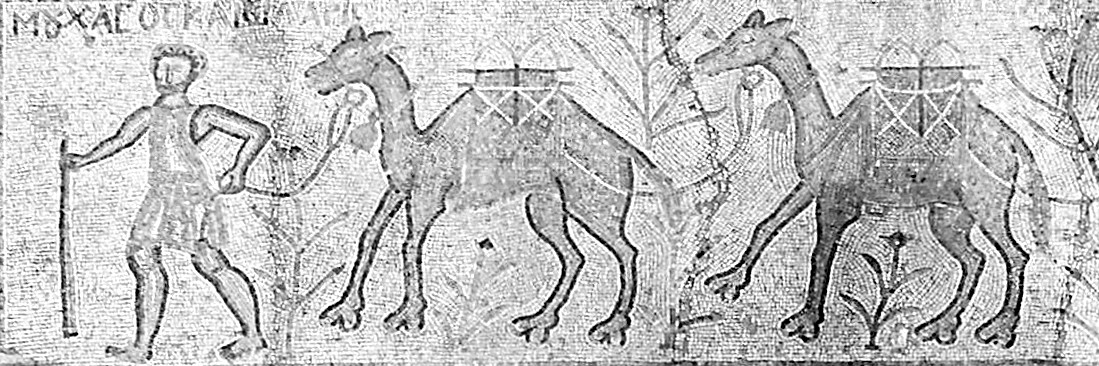
Berber pastoralists and Tuareg from the Sahara were essential for the trans-Saharan routes, acting as trading partners and guides or attacking smaller and undefended caravans. States and merchants paid tribute to these pastoralists in order to ensure the safety of their caravans.
The protector of caravans was the Palmyrene god Arsu, who originated in Arabia as Ruda.

In the relief, Arsu rides a camel towards an altar. The crescent may symbolize his association with the evening star and nighttime navigation through the desert.
From the Temple of Adonis, Dura-Europos, ca. 100–200 CE. Public domain, edited.
Routes would shift over the centuries like the sand dunes of the desert as empires rose and fell either side of the deserts and as new resources were discovered that could be exploited in the trade that never ceased.

Organized in caravans, packing camels – the ships of the desert, have traveled across all arid landscapes, from Mauritania to China, from ancient times until the twentieth century.
Small-scale camel-borne trade continues, where camels still constitute a basic form of wealth for semi-pastoralists across Africa and Asia.
War camels
Dromedaries were used in desert warfare from the mid-seventh century, mostly to transport heavy loads, like arrows and equipment for long distances without water.
They were also used as cavalry mounts, their speed and agility made them ideal for raids and surprise attacks.
Double-mounted dromedary warriors rode camels in pairs: one rider controlled the animal while the other shot arrows at enemies. This tactic made them fast, mobile fighters and proved effective in desert warfare. The method spread widely, reaching as far as India.

The conquests of the Persian Achaemenid king Cyrus the Great (559-530) would have been impossible without the logistical support of dromedaries. In c.547, he fought against king Croesus of Lydia (in western Turkey) and employed these animals in what was to become one of the most famous stratagems of Antiquity:
He gathered all the dromedaries from his army train, took off their burdens and set cavalry men upon them.
Having thus furnished them, he ordered them to go in front of the rest of the army towards the horsemen of Croesus […].
Herodotus
The horses of the Lydians had never seen or smelled dromedaries and were afraid of them. That was why Cyrus placed these animals in the Persian front line and won the battle.
Artifacts found near Palmyra in Syria show camels being used as cavalry.

The Arab warrior Mushayqat Hamayat ibn Yusuf on a dromedary, is a funerary stele from Saba. Similar warriors must have been in Cyrus’ army.
The Arabian Peninsula was marked by constant tribal warfare and the mobility provided by camels allowed Arab warriors to move swiftly across the desert, outmaneuvering their enemies.
Some of the most famous battles in early Islamic history, such as the Battle of Badr and the Battle of Uhud, involved the use of camels in combat.
This initial campaigns of Muhammad PBUH (622–632 A.D.) and his followers made extensive use of camels.

In the Battle of Badr غَزْوَةُ بَدْرٍ, the sight of the camels adorned with colorful banners and bells, is said to have caused confusion and fear in the enemy ranks of Meccan fighters.
The Muslims numbered about 300 warriors, including some young boys and old men, with about 70 camels and a smaller number of horses.
The Meccans counted almost 1000 men, almost all of them warriors in their prime, and twice as many pack animals as the Muslims.
Subsequently, Arabs used camel-mounted infantry to outmaneuver their Sassanian and Byzantine enemies during the early Muslim conquests.
Camels played an important role in the spread of Islam as the religion expanded throughout the Arabian Peninsula.

The Battle of the Camel, also known as the Battle of Basra معركة الجمل, took place in 656 outside of Basra in Iraq.
It was the first major civil war in early Islam, fought between the partisans of Ali, commanded by the fourth Rashidun caliph Ali, against the rebelling Uthmaniyya led by Aisha (widow of Prophet Muhammad◌ؒ), Talha, and Zubayr.
In the battle of Karbala مَعْرَكَة كَرْبَلَاء, which took place in 680, camels were used by both sides by the supporters of Hussein ibn Ali and the Umayyad Caliphate. Noble war horses where also used in battles.

The term used today for an armored camel used in war, Zamburak, has its roots in this battle.
The Zamburak was used extensively by the Mughal Empire in India in the 16th and 17th centuries. Camel cavalry have been used in wars throughout Africa, the Arabian Peninsula and into modern-day India, Pakistan and beyond.


During the mid-nineteenth to the early twentieth century, camels found new employment in European armies. British became the first Europeans to
form a militarised Camel Corps. The French term Méharistes derives from Mahri, the pre-modern Arabic name for the most prized breed of camels from southeastern Yemen. Mechanisation of warfare by the Second World War ended the viability of camel units.
Camels in the beliefs of Pre- Islamic Arabia
F.K. Al Ani explains, that in the Pre-Islamic times, there were certain traditional beliefs that are today contradictory to the faith of Islam. When Arab tribes became Moslem, they stopped this rituals and beliefs because they are forbidden by Islamic law.
Fara and Atira
One of the rituals in Arabia in the per-Islamic time was fara and atira. Fara was the offspring of camels which the tribes people used to offer as a sacrifice to their idols. And Atira was a camel to be slaughtered during the Arabian month of Rajab.
Belella
When a rich man or the head of a tribe died, he was always dressed nicely in new linen and was then buried. The grave was dug about four feet deep, and afterward the grave was filled in with sand. His best camel he used to ride was tied close to his grave and left in this position without offering any food or water for it till it died (this camel is now Belella).
His close relatives in the tribe also slaughtered one of his best camels on his grave. Part of the blood that was shed was then spread on his grave, as a symbol that this grave belonged to a high-ranking and rich person in the tribe. As many people as possible could attend the actual burial.
Worshiping camels

One of the oldest beliefs of Arabs is the worshiping of certain types of stones or certain colored camels. Black colored camels were worshiped by certain Arab tribes.
The name of “Zureen” was given by the tribe “Tammem” to this camel.
Bahirah, Saibah, Wasilah and Ham
A superstitious belief regarding certain types of camels according to their ages, production, or use arose with Arabs in the Pre-Islamic state.
The Bahirah involves the female camel that has given delivery five times. They then looked at the fifth delivery,
- if it was a male, they would slaughter it and give it to the men only and not the women.
- If it was a female, they would cut off its ears and one would not allow his wife, daughters, or any of his household to benefit from its hair or milk.
- But, if it died, they would share it.

The Sa’ibah is the female camel that delivers ten females, without giving birth to a single male between them. They would then set it free and no one was allowed to ride it, cut its wool, or milk it, except for a guest.
As for the Wasilah, it is the female camel that gives delivery to a female and then another female at its second delivery. They would call such a camel a Wasilah, so they used to cut off the ears of the Wasilah and let her roam free to pasture for their idols.
As for the Hami, it is the male camel whose offspring gave birth to their own offspring. They would then proclaim, this camel has Hami (protected) on its back. Therefore, they would not carry anything on this male camel, cut his wool, prevent him from grazing wherever he liked or drinking from any pool, even if the pool did not belong to its owner.
Worshiping of idols
In the Pre-Islamic time, in Arabia there were over 300 idols located in Kaaba as patrons of safety, whom the Arabs used to consult in their affairs of peace and war.
The form of consultation was by casting a sheaf of three arrows on the ground before the idol, and taking an omen from the figures made by them as they fell.
Also, other beliefs were that when a person owns 100 camels he should choose a camel and slaughter it close to his idol. They took the blood and splashed it on the Kaaba walls.
When one’s affair was successful, or if he was cured of an illness, or if his wealth increased, he would set some of his camels free. Dedicating animals to idols after perceived blessings, was later abolished in Islam.
Ritual Practices involving Camels permitted in Islam
Branding
The ownership of a camel is shown by branding it with the wasm, or characteristic mark of the tribe of the owner. The brand or tattoo is placed on certain parts of the body, so the owner can identify it easily.


Said Anas bin Malik ◌ؒ: “I took Abdullah bin Abu Talha to Prophet Mohammad (Peace be upon him) to perform Tahnik for him. I saw the Prophet (Pbuh) and he had an instrument for branding in his hands and was branding the camels of charity (sadaqa)”.
Thus, now each of the Arab tribes that are raising camels has its own brand “wasm”.
Stray camels
The general principle relating to stray camels is that if one or more camels stray from a tribal herd and are later found with another tribe, the owners can send in a demand for their return to the leader of the tribe and the camels will normally be restored.
If they are not given back, the owners have the right to watch for their opportunity and seize property, livestock, or even men of the offending tribe and keep them until their own property is surrendered.
Blood money or blood-price (dyia)
In the event of a murder being committed outside the tribe, a blood feud was established, and the relatives of the victim had the right to decide whether atonement should be made by the execution of the murderer, or by payment of a number of camels as “dyia” or blood money.
Throughout the Moslem nations, the Qur’anic law and prophet’s saying of “an eye for an eye and a tooth for a tooth” is universally understood, and strictly enforced, with slight variations to suit local conditions.
The usual blood price at the present day in Arabia according to Islamic law is 100 camels. Prophet Mohammad (Peace be upon him) finally resolved the issue of to whom the blood money should be paid when he said:
Paying blood money to the family who killed wrongly equal to one hundred camels, composed of thirty of which are bint makath female camels,
other thirty of which are bint labin (two-year old female camels),
other thirty of which are Hiqqa (a matured three-year old she- camel), and
ten more Iben labin (two-year old male camel).
This provided the full compensation of 100 camels for death, insanity, total loss of one of the senses or of both hands or feet, etc.; half compensation for injuries such as the loss of one hand, foot, eye or testicle; quarter compensation for the partial loss of both ears, and one-eight for the entire loss of one ear.
In Pre-Islamic time, blood money was practiced. However, the number of camels to be paid was different and arranged between both parties through the medium of the local ruler or sheikh. They generally agreed upon the price for a killing was fifty camels for the cousin, eight camels for a slave and the price of many thousands of camels for an important sheikh.
The use of the camel as blood money in the battles of Dahis and Al- Ghabra’ has been documented thus in the anthology of Zuhair Bin Abi Salma (Zoheyr), in his Golden Odes, described the blood money and said:
Healing of wounds ye dealed in hundreds, hundreds of debt-camels, guiltless you for the death-guilty, ending the feud of them.
In light of the above verse, the role of the she-camel as a mediator of peace is defined in relation to the counter possibility of using the animal to provoke another tribe.
The Battle of Basus – Harb al-Basus
This bloodshed took 40 years (circa 494-534 BC) between the related tribes of Bin Taghlib and Bin Bakr following the murder of a she-camel that belonged to Saad Bin Shams.
The name of the battle is traced back to al-Basus Bin Munkith, a woman who, while visiting her nephew Jasas Bin Murra, unknowingly enraged the chief of the Taghlib and Bakr tribe, Kulaib bin Rabi’a Al-Tha’labi.
The tension began as soon as Basus rode Saad’s she-camel to her nephew’s house and left the she-camel to wander into the neighboring land of Kulaib, a man known for his aggressive territoriality. As a result of recognizing the presence of a foreign she-camel, Kulaib shot an arrow into the animal.

The death of the she-camel outraged Al-Basus and caused her to vocalize her grief in a poem that incentivized Jassas to avenge his aunt and kill Kulaib.
This action, in return, triggered a war between the two tribes that lasted for four generations.
Al-Bassus’s rage can be heard in a grieving poem as she says:
By your life where I in the house of Munkith Saad would not have been wronged by a neighbor to my abodes.
But I am in a house among strangers where when the wolf attacks, it attacks my sheep.
Saad, do not be deceived but leave for you are amongst the people who are as good as dead to their neighbors
The story occupies an important place in Arabic literary culture as a famous aphorism warning against vendetta, kin-violence, and escalation.
Camels in Religious Festivals and Rituals
Camels have been an integral part of religious festivals and rituals in Islamic culture since ancient times. They are highly regarded and considered sacred by Muslims around the world.
Arabic camels are used in various religious celebrations, including the annual Hajj pilgrimage and the Eid al-Adha festival.

The five Pillars of Islam constitute the basic religious duties (arkan), which every Muslim must perform.
Shahada (Faith) – The declaration of faith
Salah (Prayer) – Performing five daily prayers
Zakat (Charity) – Giving to those in need
Hajj (Pilgrimage) – The sacred journey to Makkah
Sawm (Fasting in Ramadan) – Abstaining from food, drink, and desires from dawn to dusk
Zakat on camels

Zakat is a graded income tax; The amount one pays is determined by the wealth one possesses of cash, gold, silver, land, and animals.
It is paid once a year, directly to the needy people, and is not filtered through the government.
The alms for the camel depends upon how many camels the man owns. Also, no alms are paid on riding camels or on camels used for carrying the camp equipment from place to place.
Said Anas◌ؒ, when Abu Bakr◌ؒ (The first Caliph after the death of Prophet Mohammad, Peace be upon him) was sent to Bahrain to collect zakat (alms) from Bahrain, wrote:
“In the Name of Allahﷻ, the Most Beneficent, the Most Merciful,
These are the orders for zakat which Allah’s Messenger, Prophet Mohammad (Peace be upon him), made obligatory for every Muslim, and which Allahﷻ had ordered His Messenger to observe: Whoever amongst the Muslims is asked to pay charity accordingly, he should pay it to zakat collector and whoever is asked more than that, he should not pay it.”
Nisab of Camel Zakat
| Camel quantity | Zakat camels |
|---|---|
| 1 – 4 | None (optional charity may be given) |
| 5 – 9 | 1 sheep or 1 ewe (cash equivalent) |
| 10 – 14 | 2 sheep or 2 ewe (cash equivalent) |
| 15 – 19 | 3 sheep or 3 ewe (cash equivalent) |
| 20 – 24 | 4 sheep or 4 ewe (continuing pattern) |
| 25 – 35 | 1 one-year-old she-camel bint makhad |
| 36 – 45 | 1 two-year-old she-camel bint labun |
| 46 – 60 | 1 three-year-old she-camel haqqa |
| 61 – 75 | 1 four-year-old she-camel jaz’a |
| 76 – 90 | 2 two-year-old she-camels |
| 91 – 120 | 2 three-year-old she-camels |
| Above 120 | For every 40 camels: 1 two-year-old camel or for every 50 camels: 1 three-year-old camel |
Abu Hurairah (RA) reported that a man asked the Prophet Mohammad (pbuh), “How about someone who owns camels and does not pay charity (zakat) that is due to him?”.
The Prophetﷺ replied,
“In the same way, the owner of camels who does not discharge what is due in respect of them (their due includes their milking on the day when they are taken to water) will be thrown in his face or on his back in a vast desert plain on the Day of Resurrection, and they will trample upon him with their hoofs and bite him with their teeth.
As often as the first of them passes him, the last of them will be made to return during a day the measure whereof will be fifty thousand years, until Judgment is pronounced among (Allah’sﷻ) slaves, he will be shown his final abode, either to Paradise or to Hell”.
Also, the Prophetﷺ clarifies the type of camels to be used as charity:
Neither an old nor a defective animal, nor a male goat may be taken as charity if the collector wishes to take it.
Camels for pilgrimage
In the past and before cars and airplanes, people went to Mecca riding camels or on foot. A constant trek of pilgrims across Central Africa, from Senegal, Liberia, Nigeria and Egypt is even on the move eastward and increasing in numbers as it goes along.
A single journey may take 15 days to 3 months riding camels, depending upon how far the country is from Mecca.
The pilgrimage takes place in the month of the Muslim calendar named Dhu’l-Hijja (the month of pilgrimage to Mecca).
The Koran states about the Pilgrimage, 27–30:

And proclaim to the people the Hajj [pilgrimage]; they will come to you on foot and on every lean camel;
They will come from every distant pass, that they may witness benefits for themselves and mention the name of Allahﷻ on known days over what He has provided for them of [sacrificial] animals.
So eat of them and feed the miserable and poor.
Then let them end their untidiness [clean yourself] and fulfill their vows and perform Tawaf around the ancient House [essential circumambulation around the Kaaba or Ka‘bah, the ancient House, performed after returning from Mina, which is a core pillar of Hajj].
The Hajj requires pilgrims to perform certain rites, including the Tawaf, or circling of the Kaaba, a shrine in the center of the Great Mosque. In this ritual, pilgrims must circle the Kaaba seven times, often on foot or on camel-back.
Eid al-Adha festival: Hady (sacrificial camels) to the Sacred House

From the Prophet Mohammad (Pbuh) time when Islam first began until today, camels have been scarified in the pilgrimage Hajj.
Allahﷻsays in the Qur’an (nor of the Hady brought for sacrifice, nor the garlands). “Hady” means sacrificial camels.
It means do not abandon the practice of bringing the Hady (sacrificial camels) to the Sacred House. Also, Allahﷻ says:
Do they see that We have created for them of what Our Hands have created, the camels, so that they are their owners, Thus have We made them subject to you.
Meaning; We have subjugated them to you, so that if you wish, you can ride them, or if you wish, you can milk them, or if you wish you can slaughter them, as Allahﷻ says:
This sacrifice of camels is prescribed for you so that you will remember Him at the time of slaughter,
for He is the Creator and Provider,
nothing of its flesh or blood reaches Him, for He has no need of anything other than Himself.
Muslims from all over the world gather in Mecca to perform various acts of worship. One of them is the sacrifice of a camel, known as Qurban or Udhiyah.
It is performed on the 10th day of the Islamic month of Dhul Hijjah during Eid al-Adha عيد الأضحى or العيد الكبير Eid-al-Kabir festival after Ramadan.
The words أضحى (aḍḥā) and قربان (qurbān) are synonymous in meaning animal sacrifice, offering or oblation.
There are special auctions where camels are collected to be sold. In the morning of the first day of Eid, the camel will be slaughtered. At the time of sacrifice, Allahﷻ’s name is recited along with the offering statement and a supplication as the Prophet Muhammad ﷺ:
In the name of Allahبسم اللهﷻ
Allahﷻ is the greatest والله أكبر
O Allahﷻ indeed this is from you and for you اللهم إن هذا منك ولك
O Allahﷻ accept from me اللهم تقبل مني
Most of the camel meat will be distributed to poor and needy people in the area, and the family will keep part of the meat for their own use. The feast is shared by Muslims throughout the Muslim world.
Every Muslim who does not attend Al-hajj has to sacrifice a sheep, goat, ram or a camel on the morning of the ‘Eid, which starts on the tenth day of Dhu’l- Hijja, if he can afford to do so.
Camels fit for sacrifice must have been fattened to a good size, with no abnormalities or sign of sickness, and must be five years of age or older.
For the majority of Muslims, the qurban sacrifice during Eid al-Adha is highly stressed for its religious significance, but not farīḍah (فريضة) or compulsory by law save for in the Hanafi school of law.
It is also called the “Feast of Sacrifice” and the commemoration of the story of Prophet Ibrahim’s willingness to sacrifice his son – an act of submission to God’s command.
In the Qur’anic story, both Ibrahim and his son submit to the divine will (aslamā), making them both participants in the sacrificial act.
The Sacrifice of Ibrahim (RA)
Then when the boy reached the age to work with him, Ibrahim◌ؒ said,
“O my dear son! I have seen in a dream that I must sacrifice you. So tell me what you think.” He replied,
“O my dear father! Do as you are commanded. Allahﷻ willing, you will find me steadfast”[The Noble Qur’an 37:102].

When Ibrahim’s◌ؒ son was old enough to walk around with his father and work with him, it was revealed in a dream to Ibrahim◌ؒ that he must sacrifice his son.
The son did not question this command, just as his mother Hajar had not questioned it when Allahﷻ commanded Ibrahim to leave her and her baby son in the desert all those years ago.
‘He said, “O my father! Do as you are commanded.
If Allahﷻ wills, you shall find me of the patient”.
Both father and son were prepared for the sacrifice.
It seems impossible to us that someone could be prepared to sacrifice their beloved child. However, the family of Ibrahim were so forceful in their rejection of disobeying Allahﷻ that they threw stones at the demon. (It is this stoning that is remembered at Hajj.)
As Ibrahim◌ؒ prepared a knife to sacrifice his son and a shroud to bury him in, he couldn’t face him, so he turned his son’s face away. Then Ibrahim◌ؒ prepared to sacrifice his son – and when the knife was at his neck, he heard a voice calling to him to stop:
‘We called out to him, “O Ibrahim◌ؒ! You have already fulfilled the vision.”
Indeed, this is how We reward good-doers. That was truly a revealing test. And We ransomed his son with a great sacrifice, and blessed Ibrahim with honorable mention among later generations.’
[The Noble Qur’an 37:103-109]
Ibrahim sacrificed a white, horned ram instead of his son and, like the stoning of the pillars, we remember this sacrifice every year at Hajj.

The story represents the devotion of Ibrahim, who was ready to sacrifice his beloved son for Allahﷻ’s sake, and the reward and blessing they received from Allahﷻ as a result of their submission.
It is not the animal that matters, but the willingness to submit wholeheartedly to Allah.ﷻ
Historically, there was debate within Muslim communities regarding whom the sacrificial son was, with the dominant position emerging as it being Ishmael/Isma’il◌ؒ.
Prophet Ibrahim (Alayhi As-Salam) is considered to be one of the greatest men in the history of Islam. Allahﷻ promised to bless his descendants with prophet hood and divine scripture. This divine promise materialized through the two prophetic lines:
the descendants of Ismail, culminating in Prophet Muhammad ﷺ,
and the descendants of his son, led to the Prophets of Israel.
Referred to as Abraham in other monotheistic religions such as Christianity and Judaism, he is considered by many as the father of the prophets.
A tale of generous King Hatim al-Ta’i
Hatim al-Ta’i حاتم الطائي slaughtered several hundred camels to honor visitors, this was considered an extreme act of Bedouin generosity and hospitality.

Public domain,edited.
In fact, this and other similar stories – usually involving the slaughtering of animals, especially camels, – made him a legend in Arabic and Persian culture, and his name lives on to this day in the saying:
More generous than Hatim al-Ta’i
أكرم من حاتم الطائي.
Camels in Parades
Camels are also used in various other religious processions and events. They were used as transportation for important people in Bedouin culture. High-ranking officials, religious leaders, and important visitors to the tribe are often transported on camels as a sign of respect and honor.
The dispatch of the kiswa

Public domain, edited.
The camel has also been associated with another festivity related to hajj: the dispatch of the kiswa — a highly elaborate textile usually made of gold- and silver-embroidered silk, the production of which could take up to a year.
Each year it was transported in a ceremonial caravan featuring an empty embroidered hawdaj, called a mahmal, to cover the holy stone of Ka’ba in Mecca.
Jamal al-mahmal, or the camel that carried the empty hawdaj, was carefully selected for this honorable task.
As English observer Arthur Wavel described in his book, A Modern Pilgrim in Mecca:
The camel that has the honour of carrying it is of great size, and, I believe, of the highest breeding.

Indicative of the camel’s status is that it was given a special name and even an attendant who was commissioned to take the closest of care of the animal.
In the hajj of 1920, two camels, Nabil (honorable) and Mabrouk (blessed), were chosen to carry the mahmal or kiswah.
So concerned was the attendant with their comfort that he would breathe cigarette smoke in their nostrils to help calm their nerves.
As the camels proceeded along the procession route, the waiting crowds would blow smoke as well, a tradition that continues today in Egypt’s countryside.
Processions of Muslim pilgrims departing for Mecca

Historically, pilgrims gathered in major cities like Cairo, Damascus, and Baghdad, forming long caravans protected by military forces (Amir al-Hajj).
A passenger-less, ceremonial litter known as the mahmal, carried on a camel, often accompanied these processions, representing royal patronage.
The print shows a processions of Muslim pilgrims departing for Mecca, led by mounted guards at right, followed by a camel carrying the ornate mahmal, and musicians riding camels.
Prophet Muhammad’s birthday (Pbuh) procession
During Mawlid al-Nabi, Prophet Muhammad’s birthday (Pbuh), camels may be decorated and paraded through the streets as part of the celebrations.
Bedouin wedding procession
Camels play a crucial role in Bedouin ceremonial traditions, particularly in weddings. Women were ceremoniously transported to their new home in a hawdaj, or a canopy-like structure mounted on the camel’s back.


During a Bedouin wedding, the bride arrives at the groom’s camp on a decorated camel, surrounded by female relatives and friends.
This bridal procession is the most important part of the ceremony, and the arrival is celebrated with drumming, singing, and ululations.
On the creation of the Camel
Camels have been a significant part of Islamic stories and legends for centuries. In Islamic tradition, camels are often associated with prophets, and they are mentioned in stories from the Quran and Hadith.
The Hadiths are collections of sayings and acts of the Prophet Muhammad ﷺ gathered and written down during the 8th and 9th centuries.
The special status of a camel is based on verses in the Quran (the holy book of Muslims) and the hadith (Prophet Mohammed’s ﷺ sayings). One of the verses says,
In the name of Allah ﷻ, the beneficent, the merciful, will they regard the camels how they are created
Surah al Ghashiya, verse 17
Meaning that if one doubts the Almighty, one should look at a camel, an extraordinary creature, and all the doubts will disappear.
One of the most famous camels in religious history, Al-Qaswa, ridden by Prophet Mohammed (peace be upon him), stands out, second only to the she-camel of Prophet Saleh in terms of its significance in Arab and Islamic culture.
The She-Camel of Saleh
The She-Camel of Prophet Saleh◌ؒ was sent by God to the tribe of Thamud, located in what is now present day Saudi Arabia. The Thamud were a wealthy and powerful tribe but were also considered wicked and unfaithful to God.
The miracle of the She-Camel of God نَاقة الله
Saleh◌ؒ preached to the Thamud and warned them of the punishment of God if they did not repent and turn to righteous ways. They asked for a sign as evidence of his prophethood, and Saleh◌ؒ prayed to God for a miracle. God responded by sending a unique she-camel from a nearby mountain. It was a miraculous camel because it would produce enough milk for the entire tribe of Thamud, and the camel drank a small amount of water only as its diet.
Saleh◌ؒ instructed the Thamud tribe to honor this camel and treat it with kindness. The camel soon became an essential asset for the tribe, and they started to enjoy the camel’s milk as it provided enough for all of them. However, the tribe became greedy, and some members of the tribe started to mistreat the camel and even kill the She-Camel.
As a punishment, God struck the tribe with a severe earthquake, destroying their homes and farms, and killing all of them. The story of She-Camel is considered a powerful lesson in Islam about the consequences of disobeying God and mistreating His creation.

In some tafseers (commentaries) and narrations, it is told that the she-camel was ten-months pregnant, in others it emerged from the rock accompanied by a young calf.
Camels hold a significant cultural and religious importance in Islam, symbolizing a message of obedience to God and treating His creations with respect and kindness.
Camels and Jinns
According to the Qur’an, God created two parallel species, man and the jinn, the former from clay and the latter from fire. Beliefs regarding the jinn are deeply integrated into Muslim culture and religion, and have a constant presence in legends, myths, poetry, literature and art.

This intriguing painting shows a camel composed of intertwined humans, animals, and mythical creatures. These include demons and a qilin (a legendary creature).
Oftentimes, fantastic beasts would be used to depict mystical ideas. In this case, the composite camel represents the interconnectedness of being within the unity of God.
These supernatural creatures occupy a parallel world to that of humanity, like human beings, the jinn can also be good, evil, or neutrally benevolent. The devils among them are on a permanent mission to misguide people until the last day, whereas the righteous ones obey Allahﷻ.
Although the Quran has devoted a full Surah, i.e. Surah al-Jinn, to this creature, some scholars deny the existence of them.
Narrated by Abu Bakr bin Abi Shaybah◌ؒ, narrated by Hushaim, from Yunus, from Al-Hasan, from Abdullah bin Mughaffal Al-Muzani, who said: The Prophet ﷺ said,
Pray in the sheepfolds but do not pray in the resting places of camels, for they were created from the devils.
حَدَّثَنَا أَبُو بَكْرِ بْنُ أَبِي شَيْبَةَ، حَدَّثَنَا هُشَيْمٌ، عَنْ يُونُسَ، عَنِ الْحَسَنِ، عَنْ عَبْدِ اللَّهِ بْنِ مُغَفَّلٍ الْمُزَنِيِّ، قَالَ قَالَ النَّبِيُّ ـ صلى الله عليه وسلم ـ “ صَلُّوا فِي مَرَابِضِ الْغَنَمِ وَلاَ تُصَلُّوا فِي أَعْطَانِ الإِبِلِ فَإِنَّهَا خُلِقَتْ مِنَ الشَّيَاطِينِ “ .
Sunan Ibn Majah 769
These Hadiths on camels (may Allahﷻ have mercy on the narrators) describes them:
Prophetﷺ said,Verily the camel has been created from devils. And behind every camel is a devil.
Recorded by Saeed ibn Mansoor ◌ؒin his sunan with a mursal hasan chain (Sahih al’jami vol.2, p25).
It was narrated that ‘Abdullah bin Mughaffal Al-Muzani◌ؒ said:
The Prophetﷺ said: ‘Perform prayer in the sheep’s resting places and do not perform prayer in the camels’ resting places, for they were created from the devils.
Sunan Ibn Majah 769, Grade:Hasan
Bara’ b. Azib ◌ؒreported : The Messenger of Allahﷻ was asked about saying prayer at places where the camels kneel down. Heﷺ replied:
Do not say prayer at places where the camels kneel down because they are the places of devils.
And he was asked about saying prayer in the fold of sheep. Heﷺ replied: ‘pray there because they are the places of blessing.
Sunan Abi Dawud◌ؒ 493, Grade:Sahih
Narrated Al-Bara’ ibn Azib◌ؒ: The Messenger of Allahﷻ was asked about performing ablution after eating the flesh of the camel. Heﷺ replied:
Perform ablution after eating it. He was asked about performing ablution after eating (other) meat.
Heﷺ replied: Do not perform ablution after eating it. He was asked about saying prayer in places where the camels lie down.
Heﷺ replied: Do not offer prayer in places where the camels lie down. These are the places of Satan.
He was asked about saying prayer in the sheepfolds. Heﷺ replied: You may offer prayer in such places; these are the places of blessing.
Sunan Abi Dawud 184, similar narrative in Sahih Muslim 360a, Jami` at-Tirmidhi ◌ؒ81
However, this does not mean that they are created from the progeny of jinn or from the progeny of the devils among the jinn; rather, the meaning is that they are considered among the devils because of their nature, as the Arabs call any disobedient creature a devil.
The Prophet, sallallaahu ‘alayhi wa sallam, probably means that if a person prays in the presence of camels, he will be at risk during his prayer as the camels may get frightened, and they may hit him while in his prayer when they run away.
Narrated Hamzah ibn ‘Amr al-Aslami◌ؒ: The Messenger of Allahﷻ said:
On the back of every camel there is a devil, so when you ride them, mention the name of Allahﷻ, may He be glorified and exalted…
Narrated by Ahmad ◌ؒ2667; classed as hasan by al-Albaani in as-Silsilah as-Saheehah◌ؒ, 2271
Voices of the desert: The camel in proverbs and sayings
Camel is called ashtar شتر in Persian, and it is called gora or κάμηλος (kamēlos) in Greek and deve in Turkish, gamal גמל in Hebrew, luòtuo 骆驼 in Chinese and “onit or ऊंट oont” in Hindi. The generic Arabic name for the dromedary and the Bactrian is Ibil (ibilun) – ﻞ إﺑ
In ancient times, Arabs used the words wealth and camels interchangeably in their vernacular.
The Arabic language knows over 150 different expressions for camel and a staggering 10,046 words related to camels, capturing their diverse characteristics.
Hundreds of names were assigned to describe adult camels, herds, females, males, offspring, and camels distinguished by weight, blindness, milk production, or swiftness. Even camels carrying warriors or plagued by thirst were granted distinct names.
Al-Jamal جمل is the most common word for dromedary camel and also means “admiration” or “to be admired”.
Some names for camels from the Qu’ran are:
ibil – إﺑﻞ – camel; (Q 6:144; 88:17)
ğamal – ﺟﻤﻞ – ğimāl – ﺟﻤﺎل – camel (Q 7:40; 77:33)
bacīrun – ﺑﻌﯿﺮ – camel – (Q 12:65; 12:72;)
nāqa – ﺔ ﻧﺎﻗ – female camel(Q 7:73; 7:77; 11:65; 17:59; 26:155; 54:28; 91:13)
rikāb – رﻛﺎب – camel for riding (Q 59:6)
budn – ﺪن ﺑ – camel for sacrifice (Q 22:36)
hīm – ﻢ ھﯿ – camel crazy from thirst (Q 56:55)
Camels are also found in the Bible:
It is easier for a camel to go through the eye of a needle, than for a rich man to enter into the kingdom of God.
Matthew 19, 24
– a phrase spoken by Jesus to his disciples according to Matthew 19, 24. The “eye of a needle” might refer to a very small gate in the city wall of Jerusalem.

Since the gate was so small, only humans and no camel could pass. In the vernacular of historic Jerusalem, this gate was called the “eye of a needle.”
Regardless of these historic roots, some scholars think the proverb may, however, be based on a translation error by which the Greek κάμηλοv (camel) was confused with κάμίλίον (rope).
Accordingly, the metaphorical comparison for an extremely difficult, almost impossible endeavor should read:
“it is easier to push a rope through the eye of a needle than . . . ”
Be that as it may, tiny city gate or a translation error, with this saying the camel resounds in common parlance.
The Qur’an, puts the metaphor in the context of disbelievers who are arrogant (istakbarū) toward God’s signs . Surah 7. Al-A’raf, Ayah 40:
إِنَّ ٱلَّذِينَ كَذَّبُوا۟ بِـَٔايَـٰتِنَا وَٱسْتَكْبَرُوا۟ عَنْهَا لَا تُفَتَّحُ لَهُمْ أَبْوَٰبُ ٱلسَّمَآءِ وَلَا يَدْخُلُونَ ٱلْجَنَّةَ حَتَّىٰ يَلِجَ ٱلْجَمَلُ فِى سَمِّ ٱلْخِيَاطِ ۚ وَكَذَٰلِكَ نَجْزِى ٱلْمُجْرِمِينَ ٤٠
Surely the gates of Heaven shall not be opened for those who reject Our signs as false and turn away from them in arrogance; nor shall they enter Paradise until a camel passes through the eye of a needle.
Thus do We reward the guilty ones.
Known as Amthal أمثال, proverbs illustrate the importance of camels in daily life and moral tales.
Arabic proverbs and sayings about camels
عرج الجمل من شفّته
The camel limped from its split lip.
I.e. A bad worker blames his tools.
الجمل ما يشوف سنامه
The camel cannot see its own hump.
I.e. The pot calling the kettle black.
البعرة تدل على البعير
The camel’s dung points to the camel.
لا ناقة لي فيها ولاجمل
I have neither a male nor a female camel in it.
I.e. It doesn’t bother me.
اعقلها وتوكّل
Tie your camel, then trust in God.
I.e. Trust in God, but take precautions.
من يسرق بيضة يسرق جملاً
He who steals an egg will steal a camel.
I.e. Small wrongdoing leads to greater wrongdoing.
نباح الكلاب لا يضرّ السائر على الجمل
The barking of dogs does not harm the man riding a camel.
I.e. Ignore criticism; it cannot harm you if you stay focused.
إذا أدخل الجمل أنفه في الخيمة تبعه جسده
If the camel puts his nose in the tent, his whole body will follow.
I.e. Give him an inch and he will take a mile.
الجمل لا يرى سنامه
The camel does not see its own hump.
I.e. People do not see their own faults.
النصيحة الجيدة أثمن من جمل
Good advice is worth more than a camel.
I.e. Wise advice is extremely valuable.
من يركب الجمل يرفع باب داره
He, who rides a camel, raises the door of his house.
I.e. Your lifestyle must match your responsibilities.
من طلب ما ليس له ضاع ما بيده
He who seeks what is not his loses what he has.
I.e. Grasp all, lose all.
الجمل أغلى من الجمال
A camel is better than beauty.
I.e. Practical value is better than appearance.
إن كان عاطلاً فاشترِ له جملاً
If he is idle, buy him a camel.
I.e. Give responsibility to cure laziness.
اشرب كالجمل وانهض باكراً
Drink like a camel and rise early.
I.e. Prepare well and start early.
الموت جملٌ أسود يبرك عند باب كل إنسان
Death is a black camel that kneels at every man’s door.
I.e. Death comes to everyone.
الجمل يحمل والقراد يشتكي
The camel carries the load while the tick complains.
I.e. Those who do the least complain the most.
من أهدى على حمار رُدّ عليه بجمل
He who gives a gift on a donkey will receive one on a camel.
I.e. Good deeds are rewarded generously.
الصبر صبر الجمل
Patience like a camel
I.e. Said about someone very patient and enduring.
يشوف الجمل ما يشوف عوجة رقبته
The camel sees others but not the bend in its own neck
I.e. People notice others’ faults but ignore their own.
حمل الجمل بما حمل
The camel carries whatever it carries
I.e. Accepting everything as it is, often used when giving up responsibility or handing things over completely.
إذا وقع الجمل كثرت سكاكينه
When a camel falls, many knives appear
I.e. When someone is weak or down, others take advantage.
اللي ما يعرف الصقر يشويه، واللي ما يعرف الجمل يحمله فوق طاقته
He who doesn’t know the falcon grills it, and he who doesn’t know the camel overloads it
I.e. Ignorance leads to misuse or poor judgment.
Thank you ArabicOnline.Eu.

Often referred to as the “ships of the desert”, they symbolize the continuity of movement, work and survival in the barren and harsh environment.
Camels are not only “ships of the desert”, they are “ships of life” that have carried entire communities through history.
The slow, swaying motion you get, when riding a camel does feel like being on a boat – it’s basically desert sailing.
From the ancient past to a modern future, camels continue to embody heritage and identity. They symbolize creation, provide food and medicine, and remain an enduring economic and cultural treasure for the communities living with camels.
Here we can only give a small glimpse at the camels’ cultural heritage. There is still much more to discover.
~ ○ ~
Keep exploring:
-
The Dromedary camel is deeply embedded in the cultural heritage from western Africa, the Levant and the Arabian Peninsula to Pakistan and India. Their symbolism extends to various aspects of heritage: history, folklore, as well as religious practices. Discover the history, heritage and folklore of the Arabic Camel or Dromedary. The name Dromedary comes from Camelus (Latin) a camel and Dromeus (Greek) a runner; –arius (Latin) suffix meaning pertaining to: hence dromedarius (New Latin) a running camel. It is also called the Arabic camel or “one-humped camel”. It actually has two humps, although only the rear one is fully developed.…
-
On account of its meager demands, its endurance, and its swiftness, the dromedary is essential to desert life. The Camel is deeply embedded in the cultural and natural heritage of the communities living in semi-arid and arid landscapes from western Africa, the Leveant or Al Sham, to the Arab Peninsula to Pakistan and India. Discover history & heritage of the desert people living with the Camel or Dromedary. Watching a herder handle his camel, I saw something rare, something deeper than tradition or routine. It was connection, quiet and unspoken in a rhythm you feel more than hear. I realized…
-
Experience the thrill and tradition of the Hajjan Camel Race سباق الهجن in Wadi Hazra – Ghazaleh – Ain Khudra of January 10th, 2026, Sinai. This vibrant desert event brings together Bedouin tribes in a spectacular display of heritage, speed, and community. The camel race, more than just a competition, is a celebration of the deep bond between the Bedouin people and their beloved camels, passed down through generations. Discover the cultural significance, the powerful connection between man, animal, and the desert, and how this modern race honors centuries of tradition. Join us in exploring the unforgettable sights, sounds, and…
Works Cited & Multimedia Sources
We gratefully acknowledge the invaluable contributions of local inhabitants, farmers, scholars, and medicinal practitioners, whose knowledge, experience, and support greatly enriched earthstoriez.
- https://www.researchgate.net/publication/264326536_The_Domestication_of_the_Camel_Biological_Archaeological_and_Inscriptional_Evidence_from_Mesopotamia_Egypt_Israel_and_Arabia_and_Literary_Evidence_from_the_Hebrew_Bible
- https://quran.com/7/40
- https://wikiislam.net/
- https://www.iium.edu.my/deed/hadith/muslim/022_smt.html
- https://web.archive.org/web/20240621112203/https://www.maainternational.org.au/islamic-donations/what-is-qurban/rules-of-qurban
- https://en.wikipedia.org/wiki/Dhabihah
- https://en.wikipedia.org/wiki/Eid_al-Adha
- https://en.wikipedia.org/wiki/Binding_of_Isaac
- https://muslimhands.org.uk/islamic-resources/the-complete-story-of-qurbani-from-the-qur-an-and-hadith
- https://islamic-relief.org/qurbani/prophet-ibrahim-as-and-his-sacrifice/
- https://burujacademy.com/blog/prophet-ibrahim-story-abraham/
- https://www.jstor.org/stable/42930232?read-now=1&seq=1#page_scan_tab_contents
- the-saudi-camel-racing-singing-and-sustaining-a-desert-heritage/
- Camels in Asia and North Africa : interdisciplinary perspectives on their past and present significance Wien : Verl. der Österreichischen Akademie der Wissenschaften. 2012
- Sommer Monika. Saeed Alhaimli. Tour to Oman. 2025.
- Bridi Robert M. De Man Adriaan. From Heritage to High-Tech: The Impact of Technology on Camels in the United Arab Emirates. Department of Geography and Urban Sustainability, United Arab Emirates University, Department of Tourism and Heritage. Heritage 2025, 8(5), 165. https://www.mdpi.com/2571-9408/8/5/165.
- The IAU Working Group on Star Names (WGSN): Research Finds in 2025. Journal of Astronomical History and Heritage 28(4):1026-1038.DOI:10.3724/SP.J.1440-2807.2026.01.10
- Stetkevych Jaroslav. Muhammad and the Golden Bough Reconstructing Arabian Myth. Muammad_and_the_Golden_Bough.pdf
- https://www.101lasttribes.com
- https://iyrp.info/
- Biocultural Community Protocol of the Camel Breeders of Rajasthan https://www.pastoralpeoples.org/documents/biocultural-community-protocol-of-the-camel-breeders-of-rajasthan/
- https://www.livius.org/articles/misc/dromedaries-and-camels/
- Camelid biodiversity, population trends and geographic distribution. Camelids: Heroes of Deserts and Highlands, Nourishing People and Culture. Volume 2. Rome, FAO. 2025. https://doi.org/10.4060/cd5884en
- History of camelids. Camelids: Heroes of Deserts and Highlands, Nourishing People and Culture. Volume 1. Rome. 2025. https://doi.org/10.4060/cd5819en
- Jenet, A., N. Buono, S. Di Lello, M. Gomarasca, C. Heine, S. Mason, M. Nori, R. Saavedra, K. Van Troos. The path to greener pastures. Pastoralism, the backbone of the world’s drylands. Vétérinaires Sans Frontières International (VSF-International). B 2016.
- The Biblical Archaeologist, Vol. 56, No. 4, Nomadic Pastoralism: Past and Present (Dec., 1993), pp. 180-188
- Gall Timothy L. Encyclopedia of Cultures and Daily Life, Vols 1-5 – Worldmark. 2009.
- What+future+for+camel+pastoralism+in+the+world+ISOCARD+Maroc.pdf
- turning-camels-into-cows-megafarms-are-being-set-up-to-produce-camel-milk-on-industrial-scales
- https://pmc.ncbi.nlm.nih.gov/articles/PMC6899786/#main-content
- Female Camel Nomenclature among Arabia’s Bedouins
- http://www.ilri.org/InfoServ/Webpub/fulldocs/MONONO5/toc.htm
- https://pmc.ncbi.nlm.nih.gov/articles/PMC6389616/table/T2/
- Camels_in_Star_Mythology_and_in_Everyday_Rural_Life_Ethnographic_Observations_in_South_West_Arabia
- Star_Lore_Of_All_Ages/Cassiopeia
- Star_Lore_Of_All_Ages/The_Pleiades
- Rain-stars
- Islamic Folk Astronomy
- The_IAU_Working_Group_on_Star_Names_WGSN_Research_Finds_in_2025
- https://sci-cult.com/wp-content/uploads/5.2/5_2_3_Talafha.pdf
- https://www.101lasttribes.com/historic.html
- https://en.wikipedia.org/wiki/Pastoral_society
- https://www.youtube.com/watch?v=7GKM_XMDqmg
- https://www.youtube.com/watch?v=XFHd8hsKCvM&list=PLgz33fsrwiVl0xhdgAP7JDDf38wVPyHHq&index=5
- world-map-of-camelids
- FAO. Production, products and services. Camelids: Heroes of Deserts and Highlands, Nourishing People
- and Culture. Volume 3. Rome. 2026. https://doi.org/10.4060/cd8253en
- https://arabic-for-nerds.com/translation/arabic-words-for-camel/
- https://spa.gov.sa/en/N2025203
- https://scholarlypublications.universiteitleiden.nl/access/item%3A4178353/view
- https://books.openbookpublishers.com/10.11647/obp.0450.05.pdf (Bactrian Camel)
- https://www.aramcoworld.com/articles/2018/camels-the-magnificent-migration
- Camels in Star Mythology and in Everyday Rural Life: Ethnographic Observations in South-West Arabia’s Tihāma Lowlands
- camels-in-asia-and-north-africa
- https://www.sciencedirect.com/topics/agricultural-and-biological-sciences/camel
- https://eservices.ju.edu.jo/HSS/Article/FullText/1909?volume=34&issue=2
- https://ndl.ethernet.edu.et/bitstream/123456789/56523/1/192.pdf.pdf
- https://www.metmuseum.org/perspectives/hajj-camel
- https://web.archive.org/web/20240622184929/http://www.cameladvisor.com/spiritual-camels-religions/